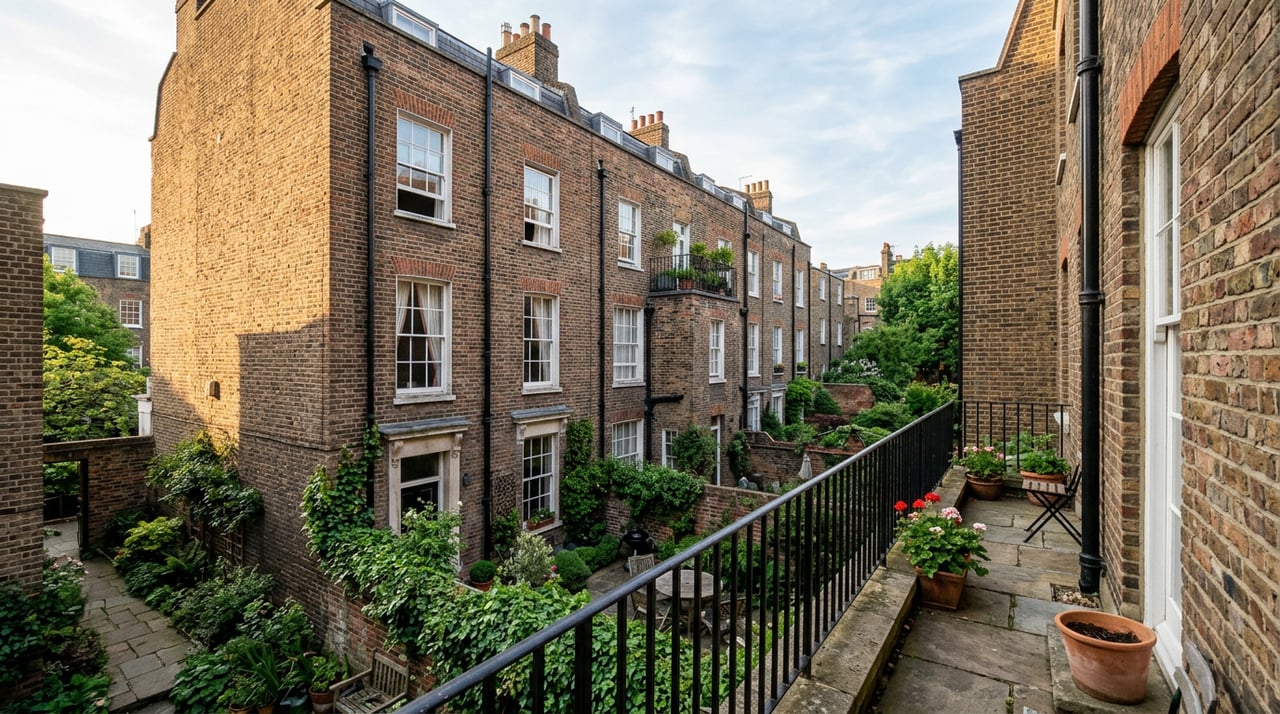
Ask someone who has lived in Flatiron for the last decade what actually organizes their week and they will not point you to Fifth Avenue or the shopping strip near Sixth. They will point you to six and a fifth acres bounded by 23rd, 26th, Fifth, and Madison. This fall, the pattern gets harder to ignore: the neighborhood's newest restaurants are opening in the area, its most famous building is finally getting its dining life back after more than a century, and the park itself now runs a printed, dated calendar with a named executive director leading tours through it. Flatiron in 2026 isn't a business district with a park in the middle. It's a park with a business district built around the edges of it.
Restaurants Are Opening Near Madison Square Park
Felice opened its newest location this June inside the historic 220 Fifth Avenue building. The Tuscan-inspired restaurant and wine bar, which built its reputation on cozy Upper East Side footprints starting in 2007, has a dining room with windows wrapping three sides and a direct sightline into Madison Square Park. It's a nearly twenty-year-old brand's largest New York opening in years.
The rest of the neighborhood's food scene is adding more nearby options at a smaller scale. El Califa De León, a new taco counter serving a tight five-item menu of gaonera, costilla, bistec, chuleta, and a vegetarian option alongside margaritas, has landed within the same few blocks. Kidilum, a South Indian coastal restaurant from restaurateurs Sidharth Sharma and Sammeer A. Raajpal with chef Vinu Raveendran, is expected to open in Flatiron this year as well. And the Flatiron NoMad Partnership's own new-neighbor updates have flagged a fresh wave of arrivals including Alidoro, Salomon, and Los Tacos No. 1, small and mid-sized operators choosing this specific stretch of Manhattan over the dozen other neighborhoods that would take them.
Madison Square Park is a distinctive feature of this stretch of Manhattan, ringed by pre-war office towers and newer high-rises, with no vehicle traffic cutting through its interior.
A Building Getting Its Dining Room Back After 124 Years
The most unusual piece of this fall's story involves a building that isn't even open yet. The Flatiron Building, the 1902 landmark at the corner of 23rd Street, is mid-conversion from office space into 37 residential condominiums, led by the Brodsky Organization and the Sorgente Group with SLCE Architects. As of April 2026, more than ten of those units had already gone into contract, including a five-bedroom apartment listed at $58.5 million, and design duties for the residences and amenity spaces have gone to AD100 designer William Sofield's Studio Sofield.
What makes the building relevant to a resident who has no interest in buying a condo is what's happening at street level. James Beard Award-winning chefs Rita Sodi and Jody Williams, the pair behind Via Carota, I Sodi, Buvette, and The Commerce Inn, are opening a new outpost of their café and bar Bar Pisellino at the base of the building. Construction started this past summer, with the space expected to open in 2027. It will be the first restaurant Sodi and Williams have opened outside the West Village in their history running that hospitality group.
There's a specific symmetry worth sitting with here. When the Flatiron Building first opened in 1902, its ground floor housed the Flatiron Restaurant, a large all-day dining room. That space later became Taverne Louis, a French restaurant and jazz club known for live music. For most of the last several decades, none of that street-level life existed. Bar Pisellino's arrival means the building is getting its dining room back for the first time in generations, not as a novelty but as a return to what the ground floor was originally built to do. The building is also slated to be illuminated at night for the first time in its history, with a new LED lighting scheme designed by L'Observatoire International, once the conversion is complete.
The Park Now Runs Its Own Calendar
The park itself has stopped being passive scenery and started running programming with the structure of an institution. Madison Square Park Conservancy, the nonprofit that raises the funds to operate the park, has a fall calendar dense enough that a resident could build a monthly routine around it, with recurring events.
| Event | Date | What it is |
|---|---|---|
| Tempestry Project: NYC Collection | Through Sept 27 | Fiber-art installation turning climate data into woven works |
| Madison Square Park: The Gilded Age, Before & Beyond | Sept 22, Oct 27, Nov 17 | History walk led by Executive Director Holly Leicht |
| Garden Walk | Oct 13 | Arboretum tour with the horticulture team |
| Roberto Lugo's "Alfarero del Barrio" tour | Oct 14 | Free 20-minute curatorial tour of the sculpture installation |
What stands out isn't any single event. It's that a public park is running recurring, dated programming with a named executive director leading history tours multiple times a season, the kind of consistent scheduling more often associated with a museum than a patch of green space between office towers. For a neighborhood resident, that turns the park from a place you pass through into a place you plan around.
The Group Behind the Curtain Just Turned Twenty
Much of what makes this fall's convergence possible traces back to an organization most residents have never had a reason to think about directly. The Flatiron NoMad Partnership, the business improvement district responsible for maintaining and marketing the area, was formed in 2006, which makes 2026 its twentieth year. It's the same group tracking new restaurant arrivals in its "New Neighbor Roundup" posts, and the same group behind recent public art moments in the district, including Charlotte Colbert's two 30-foot sculptures "Chasing Rainbows" and the installation of The Portal on the Flatiron South Plaza, a real-time video sculpture connecting the plaza to a matching installation in Dublin.
None of that public art or business tracking happens by accident. A twenty-year-old BID with an expanded footprint stretching from the park north into NoMad has spent two decades building exactly the kind of infrastructure that makes a restaurant opening or a sculpture installation land with more visibility than it would in a neighborhood without that coordination.
The neighborhood's calendar isn't dense because Flatiron got lucky this year. It's dense because an organization has spent twenty years building the scaffolding for it.
A Resident's Actual Fall Loop
Here's what that convergence looks like on the ground over the next ten weeks:
- Catch the Tempestry Project fiber installation before it comes down September 27
- Walk the Oct 13 Garden Walk to see the park's native plant beds shift into fall color
- Book the Sept 22 or Oct 27 Gilded Age history tour with Holly Leicht for context on the park you walk through daily
- Take the free Oct 14 tour of Roberto Lugo's "Alfarero del Barrio" installation
- Try El Califa De León for tacos, then check on Kidilum's opening status for South Indian coastal food
- Watch 220 Fifth Avenue for Felice's continuing rooms and keep an eye on the Flatiron Building's exterior for early signs of construction progress on Bar Pisellino
None of this requires leaving a six-block radius. That's the point.
The Takeaway
Flatiron's identity this fall isn't Fifth Avenue retail or the office towers ringing the park. It's a 6.2-acre park at the center of a neighborhood shaped over two decades by a business improvement district, alongside a James Beard-winning chef duo, a nearly twenty-year-old restaurant brand's largest New York opening in years, and a public art calendar dense enough to plan a season by. Residents who have watched Flatiron evolve for years are seeing something specific happen: the park is a defining part of the neighborhood, not just a backdrop.
If you're weighing what a home near that kind of concentrated neighborhood energy is actually worth, or thinking about what it takes to buy or sell in a market where proximity to Madison Square Park increasingly shapes both restaurant strategy and resale value, Eileen Foy has spent more than thirty years reading exactly these signals across Manhattan's East Side and mid-Manhattan neighborhoods. Request a Private Consultation to talk through what's happening in Flatiron and what it means for your next move.